| Decision | 2.5 inch hose | 4 inch hose |
|---|---|---|
| Typical source | Shop vacuum or compact extractor | High-volume dust collector |
| Machine movement | Lighter and easier to route | Heavier with a larger bend radius |
| System resistance | More restrictive over long runs | Lower potential restriction when the whole path stays large |
| Support | Still recommended | Essential near the moving carriage |
| Best reason to choose | The extractor and machine are designed around a compact hose | The collector can use the larger path and the machine can carry it safely |
Start at the extractor
Identify the collector type, its intended hose size, and every restriction between the collector and the dust boot. Long flexible runs, sharp bends, reducers, clogged filters, small cyclones, and partially closed gates can matter more than the final adapter.
When 2.5 inches makes sense
- The source is a shop vacuum or compact high-pressure extractor.
- The CNC has limited carriage clearance or a lightweight router.
- The moving hose run must be flexible and easy to support.
- The fixed ducting upstream is already 2.5 inches or smaller.
When 4 inches makes sense
- The source is a dust collector designed to move air through a 4 inch branch.
- The upstream ducting, separator, and gates preserve the larger path.
- The machine has enough space for the hose bend and enough support to keep its weight off Z.
- The work produces a high volume of chips and the collector can sustain the required flow.
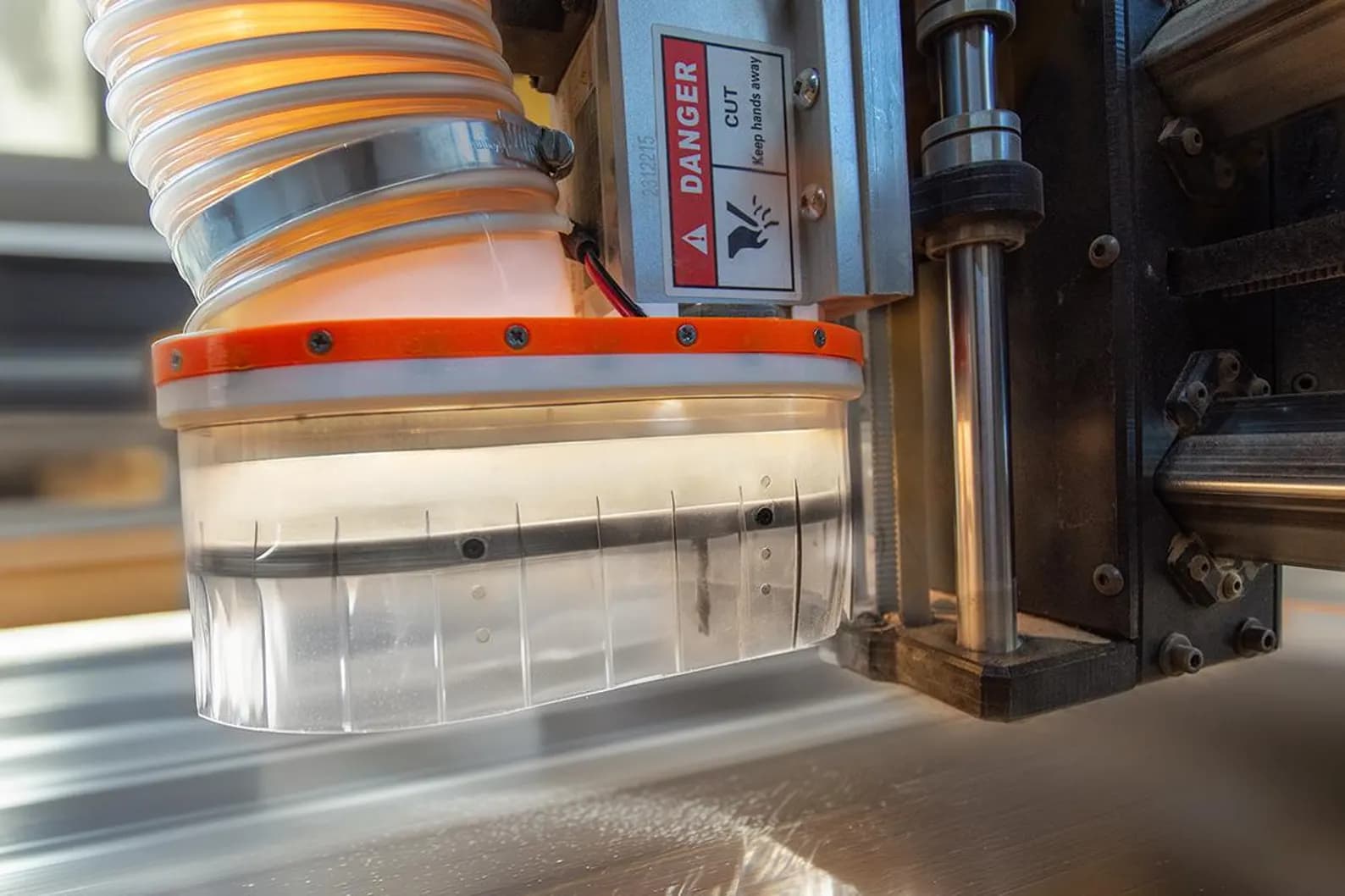
An adapter changes fit, not the collector
Dast Boot includes adapters for common 2.5 to 4 inch connections. An adapter makes the mechanical connection; it does not turn a shop vacuum into a high-volume dust collector or remove the losses in an undersized upstream system.
Hose-support checklist
Do not make the spindle mount support the suspended hose.
Avoid a tight kink where the hose leaves the boot.
Check far corners and both ends of Z movement.
Follow the extractor and hose manufacturer’s grounding guidance.
The useful choice is the hose that the extractor can drive and the CNC can move without interference.